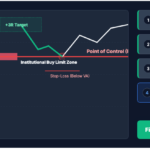
Every morning at 9:30 AM EST, Wall Street injects billions into the market. Here is exactly how professional CME day traders capture that explosive initial momentum on Micro S&P 500, Nasdaq-100, and Gold futures.
Difficulty: Beginner / Intermediate Optimal Timeframe: 5-Min & 15-Min Best Window: 9:30 AM – 11:00 AM EST
⚡ Strategy Blueprint at a Glance
Core Concept: Momentum Breakout of Initial Session Range
Top Markets: MES (S&P 500), MNQ (Nasdaq), MGC (Gold)
Opening Range Window: 9:30 AM – 9:45 AM EST (15-Min ORB)
Stop-Loss Placement: Range Midpoint (50% Level)
Profit Target: 1:2 Risk/Reward
Recommended Account: Free Unlimited Demo or $10 Micro Live
1. What Is the Opening Range Breakout (ORB) Strategy?
The Opening Range Breakout (ORB) isn’t just another indicator-based strategy; it’s a daily institutional event. Originally popularized by legendary commodities trader Toby Crabel, it focuses strictly on the first 15 minutes of regular trading hours—the exact moment when overnight institutional orders, breaking news, and retail flow violently collide.
For U.S. equity index futures—like the highly popular Micro E-Mini S&P 500 (MES) and Nasdaq-100 (MNQ)—the New York Stock Exchange cash open at 9:30 AM EST injects massive liquidity into the market. During this initial 15-minute window (9:30 AM to 9:45 AM EST), bulls and bears battle to establish the day’s first equilibrium zone, leaving behind an Opening Range High and an Opening Range Low.
When price decisively breaks outside this 15-minute battlefield on strong volume, the losing side is forced to quickly cover their positions. This short-covering fuels a sustained directional trend that frequently lasts for the next 60 to 90 minutes. That is where we take our profit.
2. Anatomy of the ORB Trade (Long & Short Setups)
The greatest advantage of trading futures is that there are no borrowing restrictions or “uptick rules.” You can profit from a market crash (Selling Short) just as easily and legally as a market rally (Buying Long). Because markets tend to fall three times faster than they rise, bearish breakdowns are often the most profitable. Here is the mechanical setup for both directions:
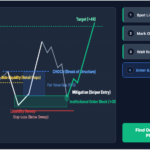
The Setup Phase: From 9:30 AM to 9:45 AM EST, sit on your hands. Do absolutely nothing. Just mark the absolute Highest price and Lowest price of this 15-minute period on your chart.
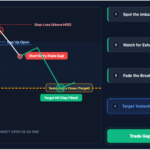
The Trigger (Entry): Wait for a 5-minute candle to close completely ABOVE the Highest price (to go Long/Buy) OR completely BELOW the Lowest price (to go Short/Sell). Execute a Market order at the exact close of that candle.
The Risk (Stop-Loss): Calculate the exact middle (50% midpoint) of your 15-minute range. Place your hard Stop-Loss there. If the price chops back to the middle of the box, the breakout has failed and you want out immediately.
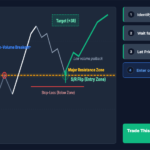
The Target (Take Profit): Measure the point distance from your Entry to your Stop-Loss. Multiply that number by 2. That is your profit target, giving you a professional 1:2 Risk/Reward ratio.
3. Step-by-Step Mechanical Trading Rules
Consistency in futures trading comes from eliminating emotions and acting like a casino. Follow this exact 4-step checklist every morning before placing a single order:
Wait Patiently (9:30 – 9:45 AM EST): Let the initial algorithmic whipsaws settle. Amateurs lose their money here. At exactly 9:45 AM EST, calmly note the high and low of the session so far.
Switch to the 5-Minute Chart: Never enter on a mere wick poking outside the range. Wait for a full 5-minute candle body to close above the Opening Range High (for a Long trade) or below the Opening Range Low (for a Short trade).
Set Your Midpoint Stop-Loss: Placing a stop at the extreme opposite of a wide range destroys your risk profile. Use the 50% midpoint of the opening box to cut losses swiftly and cleanly.
Take Profit & Trail: Once price reaches +1R in profit (the exact distance as your stop-loss), move your stop-loss to breakeven. You have now eliminated downside risk. Let the rest run into your 2R target.
Want to test this exact setup tomorrow morning?
Don’t risk real money yet. Practice marking the ORB range on a live CME data feed for free.
4. The Best U.S. Futures Contracts for the ORB Strategy
Timing is everything. Not all futures contracts experience their volume surge at the same time. Trade these specific contracts strictly during their dedicated volume windows:
Contract
Optimal Window (EST)
Point Value
MES (Micro S&P 500)
9:30 AM – 9:45 AM
$5.00 per point
MNQ (Micro Nasdaq)
9:30 AM – 9:45 AM
$2.00 per point
MCL (Micro Crude Oil)
9:00 AM – 9:15 AM
$1.00 per $0.01 tick
MGC (Micro Gold)
8:20 AM – 8:35 AM
$1.00 per $0.10 tick
5. Three Institutional Filters to Avoid False Breakouts
Novice traders lose money with ORB because they blindly trade every single breakout. Professionals apply these three simple filters to drastically boost their win rates:
The VWAP Alignment: Only take Long ORB breakouts when price is trading above the intraday VWAP (Volume Weighted Average Price) line, and Short breakouts when price is below VWAP. Never fight the broader institutional volume flow.
The Range Size Filter: If the first 15-minute candle was massive and has already moved 80% of the Average Daily Range (for example, after a wild 8:30 AM CPI news report), skip the breakout. Most of the fuel is already spent.
The 11:00 AM EST Cutoff: If price has not broken out of the 9:30–9:45 AM range by 11:00 AM EST, cancel your setup entirely. Late-morning breakouts frequently fizzle into low-volume chop.
6. Frequently Asked Questions (FAQ)
Is the 5-minute or 15-minute Opening Range better?
The 15-minute Opening Range (9:30 – 9:45 AM) offers significantly higher reliability for beginners and intermediate traders. It gives the market time to filter out the erratic, unpredictable algorithm spikes that dominate the first 5 minutes of the bell.
How much money do I need to trade the ORB strategy?
Because you are trading Micro E-Mini futures, you do not need a massive account. On regulated U.S. platforms like Plus500US, you can open an account with as little as $10. We highly recommend practicing on their free, unlimited demo account first.
What happens if my first ORB breakout gets stopped out?
Take the loss like a professional and step back. Strict discipline is essential: limit yourself to a maximum of one or two ORB attempts per morning session. If the market chops back and forth through your midpoint twice, it is a range-bound day. Turn off the screens and come back tomorrow.
Ready to Trade the Morning Breakouts?
Start with a $10 minimum deposit, $0 platform licensing fees, and instant access to a powerful CFTC & NFA regulated U.S. futures terminal.
RISK & AFFILIATE DISCLOSURE: Futures and options trading involves substantial risk of loss and is not suitable for all investors. Past performance of any trading strategy, including the Opening Range Breakout (ORB), is not indicative of future results. Always test strategies on a simulated demo account before committing risk capital. Finmarket may receive referral compensation from partner brokerages when you open an account via links on this page.