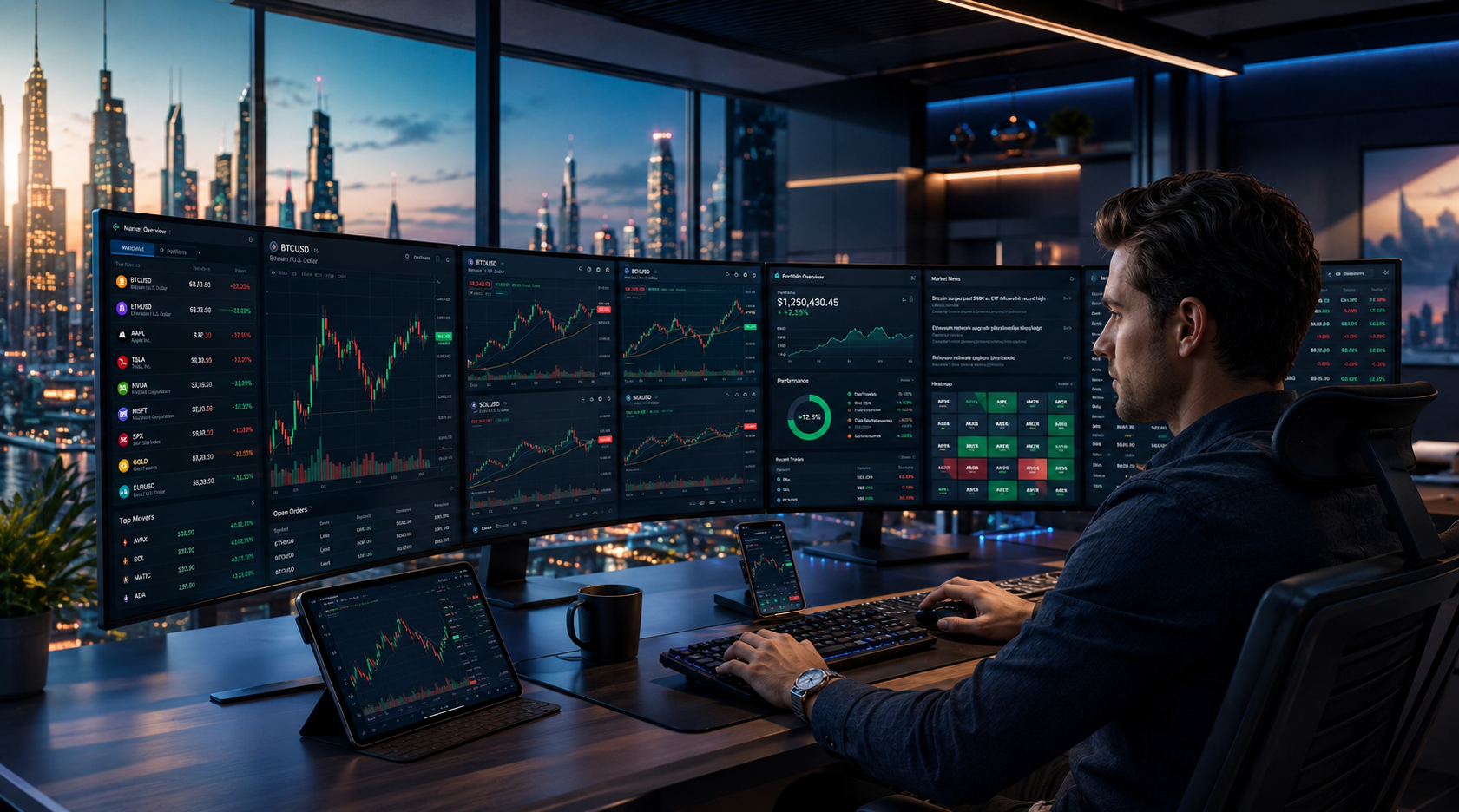
Every single day, over seven trillion dollars exchange hands across global borders. This constant, relentless flow of capital drives the entire global economy, dictating the cost of imports, exports, international travel, and corporate valuations. If you have recently started looking into financial independence, wealth generation, or portfolio diversification, you have likely asked yourself a fundamental question: what is forex trading?
At its core, fx trading (foreign exchange) is the simple act of buying one currency while simultaneously selling another. It is the invisible engine that allows international trade to function. However, for individual retail investors, it represents an entirely different landscape: a frontier of unparalleled financial opportunity. The forex market is the largest, most liquid, and most dynamic financial arena in the world, operating 24 hours a day, five days a week.
Before diving into the complex mechanics of market analysis, securing a professional and regulated trading environment is your most crucial first step. You cannot navigate global markets with subpar tools. If you are ready to explore live charts, access real-time data, and utilize advanced risk management features, you can download a premium multi-platform trading environment here. Equipping yourself with a robust forex platform right from the start ensures you are analyzing the markets with institutional-grade precision.
Understanding the Ecosystem: Who Trades Forex?
For decades, the currency and commodities markets were highly exclusive clubs. They were heavily guarded domains reserved solely for central banks, massive commercial banking institutions, multinational corporations, and elite hedge funds. These massive players trade in blocks of hundreds of millions of dollars to hedge against international currency exposure or to manage national monetary policy.
Today, rapid technological advancements and high-speed internet have completely democratized access. The modern retail forex trader can now execute trades from a laptop in a coffee shop with the same speed as a floor trader in Wall Street. But to survive alongside these financial giants, you must understand the rules of the game.
The Currency Pairs: Majors, Minors, and Exotics
In this market, you never trade a single currency; you trade pairs. When you look at your forex trading app, you will see pairs categorized into three distinct groups. Knowing which to trade is vital for forex trading for beginners:
- Major Pairs: These are the most heavily traded pairs in the world, and they all include the US Dollar (USD) on one side. Examples include EUR/USD (Euro/US Dollar), GBP/USD (British Pound/US Dollar), and USD/JPY (US Dollar/Japanese Yen). Because of their massive liquidity, they offer the lowest trading costs and the most stable, predictable price movements.
- Minor Pairs (Crosses): These pairs consist of major global currencies but do not include the US Dollar. Examples are EUR/GBP or GBP/JPY. They are slightly more volatile than majors but still offer excellent trading opportunities.
- Exotic Pairs: These pair a major currency with the currency of a developing or emerging economy, such as USD/TRY (US Dollar/Turkish Lira) or USD/ZAR (US Dollar/South African Rand). Exotics are highly volatile and carry expensive trading costs, making them risky for beginners.
The Four Major Trading Sessions
Unlike the stock market, which has a rigid opening and closing bell, the global currency market never sleeps during the workweek. It shifts across the globe through four major financial hubs. Understanding these sessions is critical because the market’s behavior changes depending on who is awake:
- The Sydney Session: The official start of the trading week. It is generally the quietest session with the lowest volatility.
- The Tokyo Session: The Asian market comes online. Pairs involving the Japanese Yen (JPY) and Australian Dollar (AUD) see increased volume.
- The London Session: The undisputed capital of forex. When London opens, liquidity and volatility skyrocket. The vast majority of daily trends are established during this window.
- The New York Session: The second-largest market. The most explosive market movements happen during the “overlap” window (from 8:00 AM to 12:00 PM EST), when both London and New York are open simultaneously.
Decoding the Market: CFDs and Futures
When you participate in these markets today as an individual, you aren’t physically calling a bank to buy physical bundles of British Pounds or barrels of crude oil to store in your garage. Instead, retail participants primarily utilize a cfd (Contract for Difference) or trade futures contracts.
These advanced financial derivatives allow you to speculate purely on the price movement of an underlying asset. Whether the market is trending upward (bullish) or crashing downward (bearish), you can theoretically position yourself to capitalize on the volatility. If you believe the Euro will strengthen against the Dollar, you “Go Long” (Buy). If you believe it will weaken, you “Go Short” (Sell). This dual-directional flexibility is what draws millions of traders to the charts every single day.
The Language of the Markets: Essential Glossary
If you are exploring how to start trading, the sheer volume of industry jargon can feel overwhelming. To navigate the markets effectively, you must speak the language:
- Pip (Percentage in Point): The smallest unit of price movement in an exchange rate. If the EUR/USD moves from 1.1050 to 1.1051, that 0.0001 rise is exactly one pip.
- Spread: When you look at an asset, you will see a Bid (sell price) and an Ask (buy price). The spread is the gap between these two numbers. It is the built-in cost of executing the trade charged by your broker.
- Leverage: A tool that allows you to control a large position with a small amount of capital. 1:30 leverage means you can control $30,000 worth of currency with just $1,000. It magnifies both profits and losses.
- Margin: The actual amount of money required in your account to open and maintain a leveraged position. It acts as a good-faith deposit.
- Lot Size: The volume of your trade. A “Standard Lot” represents 100,000 units of currency, a “Mini Lot” is 10,000 units, and a “Micro Lot” is 1,000 units.
The Two Pillars of Market Analysis
How do professionals know when to buy or sell? They rely on two distinct schools of analysis. To be a well-rounded trader, you must understand both.
1. Fundamental Analysis
Fundamental analysts look at the macroeconomic forces driving a country’s economy. A currency’s value is essentially a reflection of the health of its issuing nation. Traders monitor central bank interest rate decisions, inflation reports (CPI), employment data (such as the US Non-Farm Payrolls), and geopolitical events. For example, if the US Federal Reserve unexpectedly raises interest rates, the US Dollar will typically surge in value against other currencies because higher yields attract global investors.
2. Technical Analysis
Technical analysts ignore the news and focus entirely on the charts. They believe that all fundamental data, human emotion, and market psychology are already reflected in the price. By studying historical price action, candlestick patterns, and utilizing mathematical indicators (like Moving Averages, the Relative Strength Index (RSI), and Fibonacci retracements), technical traders identify strong levels of Support and Resistance to predict future price movements.
Choosing Your Arsenal: Broker and Platform Selection
While the definition of the “best forex broker” can be subjective depending on your location, professional-grade tools are non-negotiable. You must demand strict regulatory compliance (SEC/CFTC in the US, FCA in the UK, ASIC in Australia, or CIRO in Canada), tight spreads, and ultra-fast execution speeds.
| Platform Type | Best Suited For | Key Advantages |
|---|---|---|
| Traditional Terminals | Algorithmic traders and coders. | Highly customizable, industry standard for automated bots. |
| Proprietary Web & Mobile Apps | Modern traders and multi-asset investors. | Sleek UI, seamless device sync, built-in risk management. |
| Advanced Web Charting | Technical analysts. | The best charting visuals, massive community-shared indicators. |
Core Trading Strategies: Finding Your Edge
Entering the market without a defined strategy is gambling. You must identify a trading style that matches your personality, risk tolerance, and daily schedule:
- Scalping: Opening and closing dozens of trades within a single day, holding positions for minutes or seconds to capture tiny 2-5 pip movements. Requires intense focus and low spreads.
- Day Trading: Opening a few positions a day and closing them before the market closes. Day traders avoid overnight volatility risks and focus on intraday momentum.
- Swing Trading: Holding positions for days or weeks. Swing traders ignore short-term noise and analyze higher timeframes (daily charts) to catch major market trends. Ideal for those with full-time jobs.
Risk Management: The Secret to Longevity
Anyone can make money on a lucky trade, but keeping that money requires risk management. Professional traders follow the “1% Rule”—meaning they never risk more than 1% of their total account capital on a single trade. If you have a $10,000 account, your maximum acceptable loss per trade should be $100.
Furthermore, they utilize a strict Risk-Reward Ratio. If you risk $100 (using a Stop-Loss order) to potentially make $300 (using a Take-Profit order), you have a 1:3 ratio. With this ratio, you can lose the majority of your trades and still be profitable by the end of the month.
The Mindset of a Professional
Becoming a consistently profitable market participant is a marathon. The technical aspects of reading a chart can be learned in a week, but mastering trading psychology takes years.
Before you risk actual capital, spend time operating a forex trading demo. A demo account is a simulated, risk-free environment loaded with virtual funds. It allows you to test your strategy using live market data without the anxiety of financial loss.
The market does not reward impulsive decisions, “revenge trading” after a loss, or the Fear of Missing Out (FOMO). It rewards strict risk management, a meticulously tested trading plan, and the iron discipline to stick to that plan even during losing streaks. The global markets are always open, waiting for those prepared to navigate them professionally.
Frequently Asked Questions (FAQ)
Is forex trading legit or a scam?
Forex trading itself is a completely legitimate global market. However, the industry has scammers selling fake “guaranteed profit” courses or operating unregulated offshore brokerages. Always ensure you are trading through a strictly regulated broker.
How much money do I need to start trading?
While some brokers allow you to start with $100, trading with an undercapitalized account often leads to poor risk management. Professionals recommend starting with a free demo account first, then funding a live account with at least $500 to $1,000.
Can you get rich by trading forex?
While it is possible to generate significant wealth, it is not a “get-rich-quick” scheme. Consistent profitability requires deep market knowledge, rigorous risk management, and emotional discipline.